
At a glance (figures checked 3 November 2026)
| Topic | Key fact |
|---|---|
| Hardest hurdle | The FMGE licensing exam: 12.78% overall pass rate in June 2026, as stated by the Health Ministry in Parliament (first-time candidates: over 35%) |
| Biggest compliance risk | Programmes that do not meet NMC's FMGL Regulations, 2021 |
| Most overlooked issue | Local-language fluency for hospital rotations |
| Biggest money risk | Fee rises, exchange-rate swings and exam coaching not in the original budget |
| Biggest wellbeing risk | Homesickness, cold climate and isolation during a six-year course |
| Best protection | Your own checks against the NMC's FMGL Regulations, 2021 (a university letter or a WDOMS listing alone is not enough) and early FMGE preparation |
Why you should understand the challenges before you apply
Studying medicine abroad can work well for a prepared student with a verified university and a realistic budget. It can also go badly when families decide only on price. The students who struggle most are usually not weak; they were simply surprised. They did not expect hospital conversations in another language, an Indian licensing exam that tests a different style of question, or fee and exchange-rate changes in year four.
This article is the honest companion to our main guide on MBBS abroad for Indian students. Read that first if you want the rules, costs and country comparison; read this one to stress-test your plan.
1. The FMGE licensing exam is very hard
What it looks like: graduates cannot register to practise in India until they pass the Foreign Medical Graduate Examination (FMGE), run by the NBEMS. Pass rates are low. In a written reply to the Rajya Sabha on 28 July 2026, the Minister of State for Health and Family Welfare said the overall pass percentage in the June 2026 session was 12.78%, that the pass percentage among first-time candidates (freshers) was more than 35%, and that around 88% of the candidates who applied for that session were repeaters (Rajya Sabha unstarred question, “Declining FMGE pass rate in 2026”, sansad.in). Media reports quote slightly different percentages, from about 12.4% to 12.8%, depending on how candidates are counted; we use the figure in the Ministry’s reply. The December 2025 session, held in January 2026, was higher at about 23% to 24% according to published reports.
The same reply said the pass rate depends on several factors, including the quality of medical education, each candidate’s knowledge and exam performance. A large share of repeat candidates therefore explains part of the low overall figure, not all of it, and first-time candidates still fail in large numbers.
How to handle it:
- Begin Indian-pattern revision in the third year, not after graduation
- Solve previous FMGE and NEET-PG style questions every week
- Ask each university for the FMGE results of its Indian graduates, and speak to alumni
- Budget for coaching and at least one repeat attempt, even if you hope not to need it
Compare how this plays out in a popular destination in our guide to MBBS in Russia.
2. NMC rules and exam formats keep changing
What it looks like: the National Exit Test (NExT) was announced to replace the FMGE for foreign graduates but has been postponed several times. An NMC draft has proposed keeping the FMGE until NExT is introduced. Advisories on foreign admissions have also been reissued. A student who enters in 2026 may graduate under a different exam in 2032.
How to handle it: treat every consultant's summary as a starting point and read the primary source. Check nmc.org.in and natboard.edu.in before admission and again each year. Keep copies of the notices you relied on.
3. University recognition and NMC compliance
What it looks like: not every foreign medical programme meets the FMGL Regulations, 2021. NMC has warned students against institutions or formats that do not comply, such as programmes that split study across countries or that provide limited clinical training. A student who discovers this at graduation may be disqualified from registration.
A WDOMS listing does not establish NMC recognition either. The World Directory of Medical Schools (WDOMS) is a directory of medical schools around the world. A listing shows that a school is recorded there. It does not show that the NMC recognises the school or that its graduates are eligible to practise in India. Use WDOMS as a first check, never as the last one.
How to handle it:
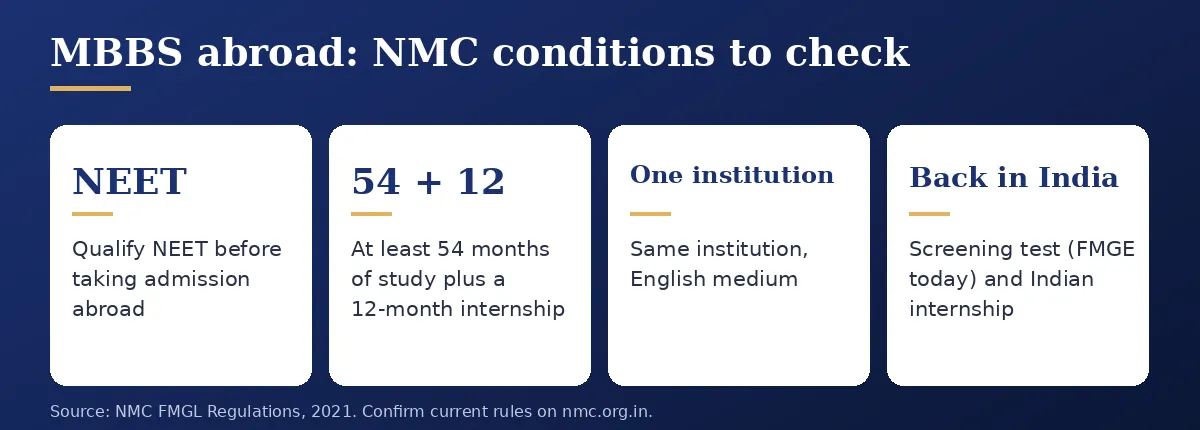
- Ask the university to confirm in writing 54+ months of study, a 12-month internship in the same institution and English-medium instruction, then check each point yourself against the FMGL Regulations on nmc.org.in. Keep the letter as a record, not as proof
- Look the university up in WDOMS and confirm its status with the host country's health authority, remembering that a listing alone does not establish NMC recognition or eligibility to practise in India
- Read the NMC's latest student advisories for any warning about the university or its programme format
- Reject any offer that includes online-only theory, twinning or clinical training in a different country
4. Language barrier in hospitals
What it looks like: lectures may be in English, but patients usually speak the local language. From the clinical years you must take histories, understand instructions and work with nurses and doctors. Students who ignore the local language often feel lost in rotations and learn less than their classmates.

How to handle it: start learning the alphabet and everyday phrases before you fly, attend every language class in year one and practise medical vocabulary with local students. Ask the university whether rotations include English-speaking supervisors.
5. Uneven clinical exposure and teaching style
What it looks like: clinical training quality differs sharply between universities. Some give students hands-on patient contact in busy teaching hospitals; others rely on theory, demonstrations or small patient volumes. Foreign courses also teach disease patterns and drugs common in their own countries, while Indian licensing exams test conditions common in India, such as tropical infections and community medicine topics.
How to handle it: ask which hospitals students use, how many patients each student sees and whether rotations are in English. Add self-study on Indian disease patterns, national programmes and guidelines alongside the foreign syllabus. Browse our partner universities and Latvia or Serbia pages to see how different destinations describe their teaching.
6. Academic pressure, attendance and exam style
What it looks like: many universities use oral exams, strict attendance and cumulative assessment. Failing a subject can delay a year, and fees continue. First-year students who are used to Indian coaching-style learning sometimes struggle with a more self-directed system.
How to handle it: keep a fixed timetable from week one, form study groups and use seniors as mentors. Ask the university for its yearly attrition rate and what support exists for students who fall behind.
Not sure which option fits your NEET score and budget?
A counsellor can review your profile, shortlist verified universities and explain the risks. Free, with no payment or commitment.
Call +91 95400 017747. Hidden costs and currency risk
What it looks like: the headline tuition figure is only part of the cost. Families also pay for hostel, food, insurance, visa and registration renewals, books, flights, exam coaching and an Indian internship later. Fees quoted in a foreign currency can rise when the rupee weakens, and some universities revise fees during the course.
| Cost surprise | How to reduce the risk |
|---|---|
| Annual fee rise | Ask whether the fee is fixed for six years and get it in writing |
| Exchange-rate movement | Keep a 10% to 15% reserve and plan payments across the year |
| Agent or "seat-blocking" charges | Pay only to the university's official account and keep receipts |
| Coaching and repeat attempts | Include FMGE preparation in the six-year plan |
| Flights and emergency travel | Budget for at least one return trip per year |
Compare totals with the cheapest countries to study abroad, and use our cost of studying abroad including living expenses guide and the page on study abroad with low bank balance requirements to understand how visa funding rules affect planning.
8. Banking, payments and geopolitical risk
What it looks like: wars, sanctions and travel advisories can disrupt flights, banking channels and the safety of students. Thousands of Indian medical students had to leave Ukraine in 2022 and then faced uncertainty about completing their degrees. Conditions in other regions can also change with little notice.
How to handle it: follow advisories from the Ministry of External Affairs and the Indian embassy, confirm with your bank how fees will be paid, avoid relying on a single payment channel and keep a plan B, such as a transfer option or a return plan. Our guide to applying safely to Russian universities shows how to verify official channels, and our Russia destination page and Serbia page list admission and funding basics.
9. Homesickness, climate, food and culture shock
What it looks like: medicine is a long, intense course, and students are often 17 or 18 when they leave home. Cold winters, limited sunlight, unfamiliar food and festivals spent alone can affect mood and study routines. Some students become isolated, which affects attendance and exam results.

How to handle it: choose a university with an active Indian student community, shared kitchen access and a clear support office. Keep a routine of sleep, exercise and calls home. Do not hide struggles; talk early to seniors, the university counsellor or family. If low mood or anxiety persists, seek professional help.
10. Safety, accommodation and daily life
What it looks like: safety and living standards vary by city and by university. Hostel quality, distance to hospitals, local transport and attitudes towards foreign students can differ from what brochures show.
How to handle it: video-call current Indian students in the same city and year, ask about incidents and emergency support, confirm hostel rules and compare off-campus rent. Register with the Indian embassy when you arrive and keep copies of passport and visa documents.
11. Misleading agents and the return to India
What it looks like: some agents promise guaranteed admission, guaranteed FMGE success or unusually low fees, and collect payments before sharing documents. After graduation, FMGE graduates must also complete the compulsory internship in India, and many report waiting months for internship placement because of administrative delays. Postgraduate competition through NEET-PG remains intense.
How to handle it: work with a consultancy that shows fees openly, explains risks and avoids guarantees. Read our guides on how to choose a study abroad consultant and study abroad consultants, and plan for a possible gap between graduation and registration. Our step-by-step process shows how we handle counselling, documents and pre-departure support, and our success stories page shows what students say about the journey.
A year-by-year plan to reduce the risks
Most challenges are easier when you spread the preparation across the whole course instead of reacting when a problem appears. Here is a simple plan that students and parents can adapt.
- Before admission: qualify NEET-UG, verify the university, collect the university's written compliance confirmation (its own statement, not an NMC approval) and check it against the FMGL Regulations, agree the six-year fee schedule and open a family conversation about budget limits and plan B.
- Year 1: settle into hostel life, attend every language class, build a daily study timetable and find two or three Indian seniors for guidance. Do not skip attendance, because rules are strict in many universities.
- Years 2 and 3: focus on basic sciences, but start a light weekly routine of Indian-pattern multiple-choice questions. Keep learning medical vocabulary in the local language.
- Years 4 and 5: during clinical rotations, take histories in the local language, keep a notebook of Indian disease patterns and national programmes, and join a coaching or study group for licensing preparation.
- Year 6 and internship: complete the internship in the same institution, collect all certificates and transcripts, and plan the FMGE attempt and Indian internship application timeline.
- After graduation: check the latest NMC and NBEMS notices, apply for the screening test, and keep a financial cushion for the months between graduation and registration.
Students who follow a plan like this are not guaranteed a pass, but they avoid the most common reason for failure: leaving all licensing preparation until after they return home.
Questions to ask before you pay any fee
A short list of direct questions often reveals more than a brochure. Ask the university and any agent to answer in writing, and compare the answers across two or three options.
- Does the programme meet each condition of the NMC's FMGL Regulations, 2021, including the 54-month course and the 12-month internship in the same institution, and who issued any “compliance” letter you are shown? (A university letter is not an NMC approval.)
- Is the full course, including clinical training, delivered in one country and one institution, and is teaching in English medium?
- What is the exact six-year fee, in which currency, and can it change during the course?
- What is the university's refund policy if I do not get a visa, or if I leave after the first semester?
- How many Indian students attempted the FMGE from this university in the last three sessions, and how many passed on the first attempt?
- Which hospitals are used for clinical teaching, and are rotations supervised in English?
- Where will I live, what does it cost and is accommodation guaranteed every year?
- Who can I contact in an emergency, and does the university have an international student office?
If an agent is unwilling to answer these questions in writing, treat that as a warning. A reliable consultancy will share documents, fee schedules and contact details of current students without pressure.
Want a written second opinion on a university or quote?
Send us the offer letter and fee schedule. We will check it against NMC conditions and tell you plainly what to ask before paying.
Contact Our TeamHow parents can support a student abroad
Parents play a large role in whether a student copes with these challenges. Stay in regular touch without turning every call into an exam-marks discussion, and ask open questions about sleep, food, friends and mood as well as studies. Keep a shared document with passport and visa copies, fee receipts, insurance details and emergency contacts. Plan at least one visit or video-call routine around festivals, since those are the moments when homesickness peaks. Finally, keep the family's financial plan flexible so that a failed exam attempt or a delayed internship does not become a crisis.
Challenges at a glance: how serious is each one?
All 11 challenges are listed below with a link to the section that explains each one. The impact ratings are our editorial judgement, not statistics.
| Challenge | Impact | Best way to reduce it |
|---|---|---|
| 1. FMGE licensing exam | Very high | Start Indian-pattern revision from year three |
| 2. Changing NMC rules and exam formats | High | Verify on nmc.org.in and natboard.edu.in every year |
| 3. University recognition and compliance | Very high | Check the university against the FMGL Regulations yourself; a university letter or WDOMS listing is not an NMC approval |
| 4. Language barrier in hospitals | High | Learn the local language from day one |
| 5. Uneven clinical exposure | High | Ask about hospitals, patient volumes and English-supervised rotations |
| 6. Academic pressure and attendance | Medium to high | Fixed timetable, study groups; ask for the yearly attrition rate |
| 7. Hidden costs and currency risk | Medium to high | Written six-year budget with a 10% to 15% reserve |
| 8. Payments and geopolitical risk | Medium to high | Follow official advisories; use official payment channels; keep a plan B |
| 9. Homesickness, climate and culture shock | Medium | Community, routine and early support |
| 10. Safety, accommodation and daily life | Medium | Video-call current Indian students; confirm hostel terms; register with the Indian embassy |
| 11. Misleading agents and returning to India | High | No payment without written terms; avoid any guarantee; plan for the internship and NEET-PG gap |
Is MBBS abroad right for you? A self-check
Answer these honestly with your family. If you answer "no" to more than two, compare alternatives before you apply.
- Have I qualified NEET-UG with a valid score?
- Can my family fund the full six years plus a reserve?
- Am I willing to learn a new language and study Indian exam content alongside the foreign syllabus?
- Have I checked the university against the NMC's FMGL Regulations myself, instead of relying only on a university letter, a WDOMS listing or an agent's word?
- Have I spoken to current Indian students and graduates?
- Can I handle living away from home for six years?
- Do I have a plan B if rules, payments or travel change?
Alternatives to consider
If the risks feel too high, compare other routes: a government or private MBBS seat in India through counselling, a drop year to improve your NEET rank, or related health-science degrees such as BDS, nursing, pharmacy or allied health. Each has its own cost and career path. If you still prefer going abroad, explore other disciplines in our courses and best places to study abroad guides, or read study abroad guidance for stage-by-stage help.
How Perspective Education Group helps you reduce these risks
Our counsellors in Noida help families compare universities on recognition, clinical exposure and total cost, review documents, explain NMC conditions and build a six-year budget with a reserve. We do not promise admission, visas or exam outcomes, and your first consultation is free. Learn more about who we are, see our services and read the FAQ. You can also explore our partner universities.

Frequently asked questions
Official sources
- National Medical Commission (India): FMGL Regulations, 2021 and student advisories
- NBEMS: FMGE notices, results and scorecards (see the FMGE section for the June 2026 result notice)
- Rajya Sabha unstarred question “Declining FMGE pass rate in 2026”, answered 28 July 2026 (primary source for the 12.78%, over 35% and 88% figures)
- Careers360 (secondary source): Health Ministry replies in the Lok Sabha on 7 August 2026 repeating the June 2026 FMGE figures
- Medical Dialogues (secondary source): report quoting the Minister’s Rajya Sabha reply
- National Testing Agency: NEET-UG information
- World Directory of Medical Schools (a directory, not an NMC approval list)
- Ministry of External Affairs: travel and student advisories
About this guide and how we checked it
Published by: the editorial team at Perspective Education Group Pvt Ltd, a study abroad consultancy based in Noida. We are a consultancy, not a regulator, university or medical college, and we work with partner universities, so we have a commercial interest in student enquiries. We have tried to describe the risks as plainly as the benefits.
Sources: regulatory and exam facts come from the NMC, NBEMS and Parliament of India sources listed above. The FMGE June 2026 figures were checked on 3 November 2026 against the Health Ministry’s reply in the Rajya Sabha.
Review status: this guide has not been reviewed by a licensed medical practitioner, and we do not list individual author credentials. It is general information, not medical, legal, immigration or licensing advice. If you spot an error or an out-of-date rule, email perspectiveeducationgroup@gmail.com and we will correct it.
Worried about the risks? Talk to a counsellor first.
Bring your questions about recognition, FMGE, fees or safety. We will give you a straight answer, with no pressure and no payment needed.
Read Our FAQRelated guides
MBBS Abroad for Indian Students: NMC Rules, Costs, Countries and FMGE
The complete guide to eligibility, costs and admission.
Related guideStudy MBBS in Russia: NMC Rules, Fees and FMGE Reality
Country-specific risks and costs.
Related guideStudy in Russia Official Website: How to Apply Safely
Avoid fake sites and unsafe payments.