
At a glance (verified 3 November 2026)
| Topic | Key fact |
|---|---|
| NEET-UG | Required before admission if you want to practise in India (NMC FMGL Regulations, 2021) |
| Minimum study period | 54 months in one institution, plus a 12-month internship in the same institution |
| Screening test in India | FMGE (NExT announced but repeatedly deferred; confirm on nmc.org.in) |
| FMGE pass rate, June 2026 | About 12.78% overall; first-time candidates above 35% (government statement in Parliament) |
| Indicative six-year budget | About ₹20 lakh to ₹50 lakh or more, varying by country and university |
| After FMGE | Compulsory rotating internship in India, then NMC or State Medical Council registration |
What is MBBS abroad?
MBBS abroad is the route in which an Indian student completes a primary medical qualification (equivalent to the Bachelor of Medicine and Bachelor of Surgery) at a university outside India. Most students then return home, qualify for registration with the National Medical Commission (NMC) and practise as doctors in India. Others use the degree to work in the country where they studied or to prepare for exams such as USMLE or PLAB.
Studying medicine abroad is not a shortcut. The degree is the same length and the subjects are the same: anatomy, physiology, biochemistry, pathology, pharmacology, medicine, surgery, paediatrics and obstetrics. What changes is the admission process, the cost, the language of daily life and, most importantly, the extra licensing hurdles Indian graduates face when they come back.
This guide is written for students and parents who are still comparing options. It follows the NMC's Foreign Medical Graduate Licentiate (FMGL) Regulations, 2021, and flags where rules are still moving. If you want to know what can go wrong, read our companion article on the challenges of studying MBBS abroad for Indian students.
Why do Indian students choose MBBS abroad?
Short answer: because the number of NEET candidates is far larger than the number of MBBS seats in India, and private seats in India can cost more than some foreign degrees.
More than 20 lakh students appear for NEET-UG every year, while India has roughly 1.2 lakh MBBS seats across government and private colleges. A student who scores well but misses a government seat may face private-college fees that run into tens of lakhs per year in some states. Foreign universities, especially in Europe and Central Asia, publish lower tuition and accept NEET-qualified students with a simpler admission process.
- Seat shortage in India: competition for government seats is intense, and many qualified students are left without a seat.
- Lower published fees: total six-year budgets in several countries are below what private colleges in India charge.
- English-medium programmes: many universities run dedicated English-taught batches for international students.
- Exposure to a new system: students learn in international classrooms and, in some countries, in modern simulation labs.
These advantages are real, but they only help if the university meets NMC conditions and the student is ready for a demanding exam at the end. That is why a careful, documented decision matters more than the lowest quote.
Is MBBS abroad valid in India? NMC rules explained
Short answer: yes, but only if you meet the conditions in the NMC's FMGL Regulations, 2021, and pass the screening exam. A foreign degree alone does not give you a licence to practise in India.
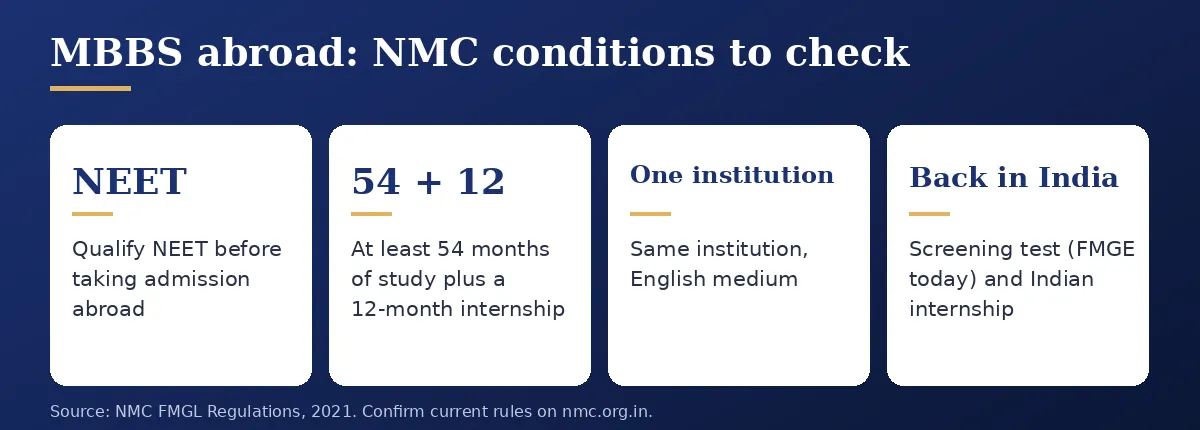
The regulations came into force in November 2021 and have been repeated in NMC advisories to students. In plain language, the main requirements are:
- Qualify NEET-UG before taking admission to a foreign medical course. The score must be valid in the year of admission.
- Complete at least 54 months of medical education in one foreign institution, with the full course and clinical training done in the same country.
- Complete a 12-month internship in the same foreign institution. Twinning, split or online-only programmes put your eligibility at risk.
- Hold a degree that lets you practise in the country where it was awarded, from a recognised institution, taught in English medium.
- Pass the screening test (the FMGE today; the National Exit Test, NExT, has been announced but repeatedly deferred) and then complete a compulsory rotating internship in India before permanent registration.
Eligibility for MBBS abroad
Universities set their own cut-offs, but an Indian student planning to return and practise should expect these minimum requirements:
- Class 12 (or equivalent) with Physics, Chemistry, Biology and English, usually with at least 50% aggregate for general category and a lower threshold for reserved categories
- A valid NEET-UG qualification
- Minimum age of 17 years on or before 31 December of the admission year
- A valid passport with enough validity for the full course
- Medical fitness certificates and a clean police clearance, depending on the country
Keep your NEET scorecard, mark sheets and identity documents ready before you speak to any university or consultant. If your NEET score is low, do not assume that foreign admission is automatic: universities still run their own selection and verify documents.
Which are the best countries for MBBS abroad?
There is no single best country. The right choice depends on budget, language comfort, safety, the strength of the individual university and its track record with Indian graduates. The table below compares three destinations that families most often ask us about. Figures are indicative ranges from published university and agency sources and must be confirmed in writing for your chosen university.
| Factor | Russia | Serbia | Latvia |
|---|---|---|---|
| Typical course length | 6 years including internship | 6 years | 6 years |
| Indicative six-year budget | About ₹20 lakh to ₹45 lakh | Mid-range; confirm per university | Higher than Russia; EU-level tuition |
| Teaching language | English batches; clinical work mostly in Russian | English-taught programmes for international students | English-taught in Riga |
| Climate and lifestyle | Cold winters, large student cities | Moderate, European lifestyle | Baltic climate, EU city life |
| Key risk to check | Payments, flights and advisories linked to sanctions | Clinical exposure and NMC compliance | Higher cost and seat availability |
| Read more | Study in Russia | Study in Serbia | Study in Latvia |
Other countries frequently marketed to Indian families include Georgia, Kazakhstan, Kyrgyzstan, Uzbekistan, the Philippines, Nepal, Bangladesh and China. Some of them have produced good outcomes for individual universities, while NMC has also warned students about institutions that do not follow FMGL rules. Treat every country as a shortlist, not a guarantee, and judge the university rather than the flag.
MBBS in Russia: what to know
Russia remains one of the most searched destinations because public medical universities publish relatively low tuition and run English-medium batches. Typical published ranges are about ₹2.3 lakh to ₹7.5 lakh tuition per year, with hostel and living costs on top. The trade-offs are cold winters, the need to learn Russian for hospital work, and payment and travel conditions that can change quickly because of sanctions and the Russia-Ukraine conflict.
Read our detailed guides on MBBS in Russia, the cost of study in Russia and the Russian government scholarship. Always verify any admission website using our guide to the official Study in Russia website.
MBBS in Serbia and Latvia: European options
Serbia and Latvia appeal to families who want a European setting and are willing to compare costs carefully. Serbia offers English-taught medicine, dentistry and pharmacy at its public and private universities, mostly in Belgrade and Novi Sad. Latvia is an EU member where Riga's universities teach medicine in English, usually at a higher price than Russia.

For both countries, the question that matters is not the country brand but the individual faculty: its NMC compliance, clinical hospital access, English-taught clinical rotations and the results of past Indian graduates. Our country pages explain admission steps, documents and bank-balance expectations for Serbia and Latvia.

Not sure which option fits your NEET score and budget?
A counsellor can review your profile, shortlist verified universities and explain the risks. Free, with no payment or commitment.
Call +91 95400 01774How much does MBBS abroad cost for Indian students?
Short answer: published six-year budgets usually fall between about ₹20 lakh and ₹50 lakh, but the real figure depends on tuition, hostel, food, insurance, flights, exchange-rate movement and licensing-exam preparation. Always compare the total for the full course, not the first-year fee.
| Cost item | What to ask the university |
|---|---|
| Tuition for all years | Is the fee fixed for six years, and in which currency? |
| Hostel and food | Is accommodation guaranteed every year, and what does it cost? |
| Health insurance, visa and registration | Which costs recur every year and which are one-time? |
| Books, uniforms and lab fees | Are they included in tuition or charged separately? |
| Flights home | How many trips per year are realistic for your family? |
| FMGE preparation | Coaching, mock tests and study material after or during the course |
| Contingency | A reserve for currency swings and emergencies |
Build a written six-year budget and keep a 10% to 15% reserve. If the total quote looks far below every other university, ask what is excluded. Our cost of studying abroad guide and the page on cheapest countries to study abroad show how living expenses add up, and the study abroad under 10 lakhs guide explains why a full MBBS rarely fits that budget.
FMGE and NExT: what happens after you graduate?
Short answer: you must pass India's screening test before you can register. Today that test is the FMGE, conducted by the National Board of Examinations in Medical Sciences (NBEMS). It is difficult, and results have been low.
- June 2026 session: the government told Parliament that the overall pass rate was 12.78%, with first-time candidates passing at over 35% and the large majority of test-takers being repeaters.
- January 2026 session: reports put the pass rate at roughly a quarter of candidates.
- NExT: the National Exit Test was meant to replace the FMGE but has been deferred repeatedly. An NMC draft has proposed keeping the FMGE until NExT is rolled out.
The lesson is practical. Students who treat licensing preparation as a six-year project, using Indian-pattern question banks from the third or fourth year, do much better than those who start after graduation. A first-attempt pass saves a year or more of waiting, repeat fees and stress. Ask every university for the FMGE results of its Indian graduates, and speak to alumni rather than relying on brochures. For deeper detail on exam outcomes at one popular destination, read our MBBS in Russia guide.
How to choose a medical university abroad
- Verify recognition. Check that the university is listed in the World Directory of Medical Schools and recognised by the health authority of its own country.
- Get NMC compliance in writing. Ask for a letter confirming 54+ months of study, a 12-month internship in the same institution, English-medium teaching and clinical training in the same country.
- Examine clinical exposure. Ask which hospitals students use, how many patients they see and whether rotations are in English.
- Check Indian graduate outcomes. Request FMGE pass data and contact at least two current Indian students and two graduates.
- Read the fee contract. Confirm the full six-year cost, currency, refund rules and official bank account details.
- Review safety and daily life. Ask about hostel quality, Indian food, local transport and emergency support.
- Avoid pressure. Any agent who rushes you to pay a seat-blocking fee before showing documents should be treated with caution.
MBBS abroad admission process, step by step
- Qualify NEET-UG. Without a valid qualification, admission is not usable for practising in India.
- Counselling and shortlist. Compare three to five universities on cost, recognition and outcomes.
- Apply with documents. Submit the application, passport and academic records to the university.
- Receive the offer or invitation letter. Read every clause and pay fees only to the university's official account.
- Visa process. Complete embassy or consulate steps, medical tests and any attestations.
- Pre-departure. Arrange insurance, flights, accommodation and a basic language course.
- Arrival and registration. Complete local registration, medical checks and orientation.
Timelines differ by country, and visa decisions are made by the relevant authorities, not by consultants. See our how it works page and the study abroad guidance hub for the stages we support.
Documents required for MBBS abroad
- NEET-UG scorecard and admit card
- Class 10 and Class 12 mark sheets and certificates
- Valid passport (and photographs in the required format)
- Birth certificate and, where requested, parents' identity documents
- Medical fitness certificate, HIV test and other tests required by the destination country
- Police clearance certificate where required
- Bank statement or sponsor documents showing the funds the visa office asks for
- Offer or invitation letter from the university and proof of fee payment
Attestations, translations and apostille requirements vary by country. Start collecting documents several months before the intake so a missing stamp does not cost you a year.
Scholarships and financing for MBBS abroad
Full scholarships for medicine are competitive and uncommon. Some governments, including Russia, offer quota-based scholarship places for international students, and some universities offer partial fee waivers based on marks. Be careful with anyone who promises a "guaranteed scholarship" for a fee. Read our guides on study abroad scholarships and the Study in Russia scholarship for the types, eligibility and how to apply.
Many families finance MBBS abroad through education loans. Compare interest rates, moratorium periods and collateral requirements across banks, and make sure the loan covers the full six years, because a mid-course funding gap is one of the most stressful problems students face.
MBBS abroad vs MBBS in India
| Factor | MBBS in India | MBBS abroad |
|---|---|---|
| Entry | NEET-UG rank and counselling | NEET-UG qualification plus university admission |
| Cost | Low in government colleges; high in many private colleges | Often lower overall, but with extra costs and exchange-rate risk |
| Licensing | Registration after final exams and internship | FMGE or equivalent plus an Indian internship |
| Clinical training | Exposure to high patient volumes in India | Varies widely by university and country |
| Language | English and local language familiar to the student | New language for patient communication |
| Risk profile | Seat availability and fees | Regulatory change, travel, payments, licensing exam |
If you can secure a government or reasonably priced private seat in India, that path usually carries fewer regulatory risks. MBBS abroad makes sense when you have a clear budget, a verified university and a plan to prepare for the Indian licensing exam from the start.
Want a written second opinion on a university or quote?
Send us the offer letter and fee schedule. We will check it against NMC conditions and tell you plainly what to ask before paying.
Contact Our TeamWho should consider MBBS abroad?
MBBS abroad suits students who have qualified NEET, are self-disciplined, are comfortable living away from family for six years and can afford the full budget without depending on a single payment route. It suits families who have compared at least two alternatives and who understand that the licensing exam is a separate, serious hurdle.
It is a poor fit for students who want a shortcut, who will not study Indian-pattern content alongside the foreign syllabus, or whose family would be unable to cover a delay of one or two years if exam results or rules change.
Common mistakes and scams to avoid
- Choosing the cheapest quote without checking recognition and clinical facilities
- Believing promises of "guaranteed admission" or a "guaranteed FMGE pass"
- Paying seat-blocking fees to personal accounts or agents instead of the university's official account
- Joining programmes that split study between countries or offer online-only theory without compliant clinical training
- Skipping the local language because lectures are in English
- Ignoring NMC notices until the final year
- Not keeping copies of receipts, offer letters and emails
If you are unsure about an agent or a quote, ask for a second opinion. We explain the red flags in our guides on choosing the best study abroad consultant near you and study abroad consultants.
Career options after MBBS abroad
After clearing the screening test and the compulsory internship in India, graduates register with the NMC or a State Medical Council and can practise, work in hospitals and apply for postgraduate seats through NEET-PG. Some graduates pursue pathways overseas, such as USMLE or PLAB, which have their own eligibility and recognition rules. Government job rules and postgraduate competition vary, so plan your career steps with the current NMC and state notices in hand.
How Perspective Education Group can help
Perspective Education Group is a study abroad consultancy in Sector-18, Noida, guiding students from across India. For medicine, we help you compare countries and universities on cost, recognition and risks, check documents, understand NMC conditions and plan the full budget. We do not promise admission, visas or exam results, and your first consultation is free.
- Talk to our MBBS abroad consultants in Noida for a free first consultation
- Browse our study destinations and partner universities
- Explore our services and read success stories
- Delhi NCR families can meet us through our Delhi study consultant page, or see the India-wide consultant directory
MBBS abroad guides by country and topic
Go deeper on the country or step you are considering. Each guide leads with the NMC conditions and what to verify.
- Countries: Russia, Georgia, Kazakhstan, Kyrgyzstan, Uzbekistan and the Philippines
- Topics: eligibility, after NEET, admission process, fees and how to check a university
From the MBBS abroad blog
Read: Best Countries for MBBS Abroad: How to Choose · NMC Guidelines for MBBS Abroad Explained · MBBS in Russia vs Georgia · MBBS in India vs Abroad · FMGE and NExT Requirements After MBBS Abroad · Challenges of studying MBBS abroad.
Frequently asked questions
Official sources
- National Medical Commission (India): FMGL Regulations, 2021 and student advisories
- NBEMS: FMGE notices, results and scorecards
- National Testing Agency: NEET-UG information
- World Directory of Medical Schools
- Ministry of External Affairs: travel and student advisories
- Careers360 report on the Health Ministry's statement in Parliament on the FMGE June 2026 pass rate
Planning MBBS abroad? Get an honest second opinion.
Share your NEET score, budget and shortlist. A counsellor will check recognition, compare costs and explain the risks before you pay any fee.
Compare Study DestinationsRelated guides
Challenges of Studying MBBS Abroad for Indian Students
Eleven real problems and how to manage each one.
Related guideStudy MBBS in Russia: NMC Rules, Fees and FMGE Reality
A deep dive into the most searched destination.
Related guideCost of Study in Russia for Indian Students 2026
Tuition, hostel and living costs in rupees.