
Study MBBS in Georgia is among the most searched options for Indian students, and Business Standard estimated in October 2026 that 20,000 to 25,000 Indian students are enrolled in Georgian medical programmes. In Georgia the degree is called a Medical Doctor (MD) and runs for six years. Whether it lets you practise in India depends on the NMC’s FMGL Regulations, 2021, and on a point the NMC clarified in September 2026.
Quick answer: Studying MBBS (MD) in Georgia takes six academic years. To keep the option of practising in India you need NEET before admission, a programme that meets the NMC course and internship conditions, and a licence to practise in Georgia at par with Georgian citizens (Regulation 4(b)). In September 2026 the NMC said junior doctor status counts only if it legally permits that level of practice, so verify before paying.

Key facts: MBBS in Georgia at a glance
| Degree | Medical Doctor (MD), commonly treated as the equivalent of the Indian MBBS |
|---|---|
| Duration | Six academic years; at least 360 ECTS credits according to a statement attributed to NCEQE |
| Sixth year | A mandatory internship at the university’s clinical bases, as reported |
| Teaching language | English-taught programmes are offered; ask about Georgian for patient contact |
| NEET | Required if you want to practise in India (FMGL Regulations, 2021) |
| Main risk to check | Regulation 4(b): a licence to practise at par with Georgian citizens |
| Accreditation | Georgian MD programmes are accredited by NCEQE |
| Last reviewed | 17 November 2026 |
Is MBBS in Georgia valid in India?
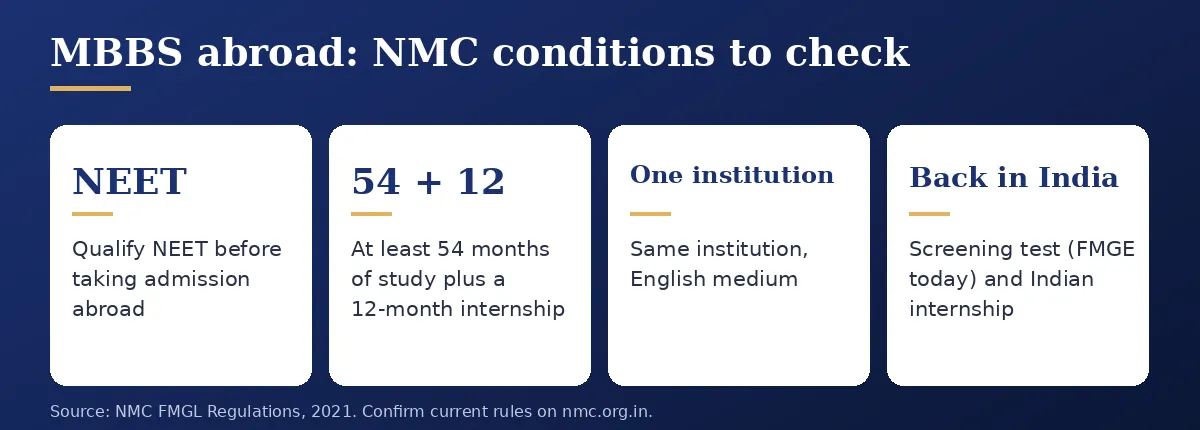
A foreign degree alone does not give a licence to practise in India. You must meet the NMC conditions below, pass the screening test and complete the Indian internship.
- NEET qualification before taking admission abroad.
- At least 54 months of medical study, plus a 12-month internship in the same foreign institution.
- The whole course at one institution in one country, taught in English medium.
- Passing India's screening test (the FMGE today) and completing the Indian internship before permanent registration.
Regulation 4(b) adds that a foreign medical graduate must hold a licence to practise medicine in the country where the degree was obtained, at par with the licence granted to that country’s own citizens. This is the point on which Georgia has attracted attention.
What the NMC and Georgia have said, as reported
- 29 September 2022: a revised advisory from the Indian Embassy in Yerevan, which also covers Georgia, said MD graduates could work as junior doctors in a supervised, non-independent role (reported by Medical Dialogues).
- 24 September 2026: responding to a grievance on the PM Grievance Portal, the NMC said Regulation 4(b) requires a licence to practise at par with citizens, and that junior doctor status satisfies it only if it legally permits medical practice at the required level (reported by PTI via Careers360 on 8 October 2026).
- October 2026: Georgia’s National Center for Educational Quality Enhancement (NCEQE) was reported to say that MD programmes last at least six academic years and that the sixth year is a mandatory internship at the university’s clinical bases (reported by The Tribune on 22 October 2026).
- Since then: Medical Dialogues has reported that NMC responses on FMGE eligibility for Georgia graduates have not been consistent.
Positions are still evolving. Read the primary notices on nmc.org.in and ask any university or consultant to show, in writing, how the specific programme satisfies Regulation 4(b).
What junior doctor status means and why it matters
Under Georgian rules, MD graduates can work as junior doctors without a further examination, but reports describe this as a supervised role. The NMC’s point is that if independent practice in Georgia is allowed only after further postgraduate certification, junior doctor status alone would not meet Regulation 4(b). Families should treat any assurance that it “automatically” qualifies you for the FMGE as unverified until it is backed by an NMC document.
How to verify a Georgian MD programme before you pay
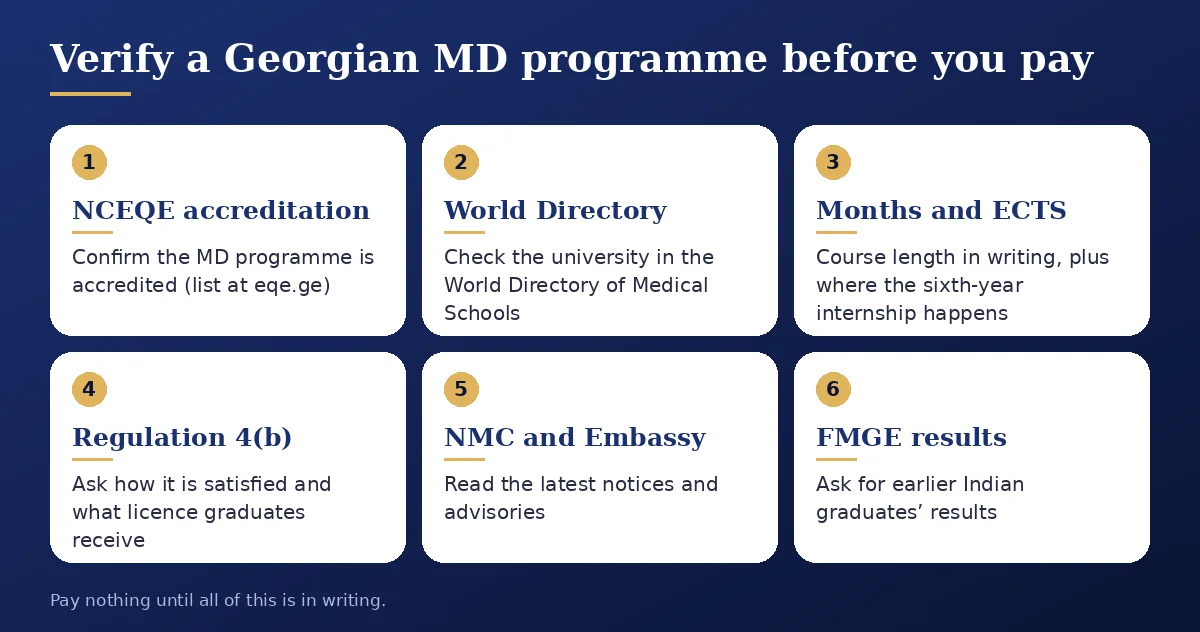
- Confirm that the university’s MD programme is accredited by NCEQE (the list is published at eqe.ge).
- Check the university in the World Directory of Medical Schools.
- Ask in writing for the course length in months and ECTS credits, and where the sixth-year internship takes place.
- Ask in writing how the programme satisfies Regulation 4(b), and what licence Georgian graduates receive.
- Read the latest NMC notices and any advisory from the Indian Embassy.
- Ask for FMGE results of earlier Indian graduates from that university.
- Pay nothing until all of the above is in writing.
The same checklist applies to any country. See how to check a medical university abroad.
Course structure, internship and language
Georgian medical programmes are commonly structured as six years, with basic and pre-clinical subjects in the early years and clinical rotations from around the fourth year, according to programme information published in Georgia. The NMC conditions refer to a 12-month internship in the same institution, so ask exactly how the sixth year is organised and documented.
English-taught programmes are offered, but hospital work involves patients, so ask each university how much Georgian is expected in the clinical years.
Budget: what to include
Compare universities only with written fee schedules for all six years, plus hostel, food, insurance, visa, flights, FMGE preparation and the Indian internship. Our MBBS abroad fees guide lists what a real budget includes, and the post on student living costs covers the rest.
After graduation: FMGE and the Indian internship
Foreign medical graduates must pass India’s screening test, currently the FMGE conducted by NBEMS, and complete the Indian internship before permanent registration. NExT has been announced but deferred. Our guide to FMGE and NExT requirements explains the exam and how to prepare.
Who should consider MBBS in Georgia, and who should wait
It may suit students who have qualified NEET, are comfortable with the unresolved Regulation 4(b) question, have checked a specific accredited programme in writing and have a budget for the full course. It is a poor fit for families who need certainty about FMGE eligibility today, or who are being pressured to pay quickly. If that describes you, wait for the NMC position to settle or compare alternatives.
Compare before you decide
Read our comparison of MBBS in Russia vs Georgia, then explore Study MBBS in Russia, Study MBBS in Kazakhstan, MBBS in Kyrgyzstan, MBBS in Uzbekistan and MBBS in the Philippines. For the full picture, start with our guide to study MBBS abroad, or check eligibility, options after NEET and the admission process.
How Perspective Education Group helps
Perspective Education Group reviews your NEET result and documents, shortlists programmes and puts in writing how each one meets the NMC conditions. Where a point is unresolved we say so plainly. The first consultation is free, and we never promise admission, visas or exam results. Talk to our MBBS abroad counsellors in Noida.
Rules and advisories change. Confirm the current position on nmc.org.in and with the university in writing before you pay. We never promise admission, visas or exam results.
Sources and further reading
Reports used for this page: PTI report via Careers360 (8 October 2026); Business Standard (27 October 2026); Medical Dialogues (1 October 2026); The Tribune explainer (22 October 2026); and the National Medical Commission FMGL Regulations, 2021. Media reports are secondary sources, so confirm against the NMC’s own notices.
Frequently asked questions
Is MBBS in Georgia valid in India?
Only if the programme meets the NMC conditions (NEET before admission, at least 54 months plus a 12-month internship, English medium) and the graduate satisfies Regulation 4(b), a licence to practise in Georgia at par with citizens. Verify both in writing before you pay.
How many years is MBBS in Georgia?
Six academic years. A statement attributed to Georgia's quality body NCEQE says MD programmes carry at least 360 ECTS credits and that the sixth year is a mandatory internship. Confirm the exact structure for your university.
What did the NMC say about Georgia in September 2026?
Replying to a grievance on 24 September 2026, the NMC said junior doctor status in Georgia satisfies Regulation 4(b) only if it legally permits medical practice at the required level. Read the NMC's own notices for the current position.
What is junior doctor status in Georgia?
Reports describe it as a supervised, non-independent role open to MD graduates. Whether it equals a licence to practise at par with Georgian citizens is the question the NMC raised, so ask for written proof.
Is NEET required for MBBS in Georgia?
If you want to practise in India afterwards, yes. The FMGL Regulations, 2021 require Indian students to qualify NEET before taking admission to a foreign medical course.
Is the MD in Georgia the same as MBBS?
In Georgia the first medical degree is called Medical Doctor (MD) and is commonly treated as the equivalent of the Indian MBBS. Validity in India still depends on the NMC conditions.
Do I need to learn Georgian?
Teaching may be in English, but hospital work involves patients, so ask each university how much Georgian is expected in clinical years.
How do I check that a Georgian medical programme is accredited?
Georgian programmes are accredited by NCEQE, whose list is published at eqe.ge. Also check the World Directory of Medical Schools, then ask the university to confirm accreditation in writing.
Can a consultant guarantee FMGE eligibility for Georgia?
No. Eligibility depends on the NMC regulations and how they are applied. Be wary of anyone who promises it, and ask to see the reasoning in writing.