
Judge the university, not the country. A good choice meets the NMC’s FMGL Regulations, 2021, teaches in English with real clinical exposure, and can show results from earlier Indian graduates. The checklist below applies to any country, and it ends with questions you can paste into an email to any admissions office.
Quick answer: To verify a medical university abroad, check six things in order: that it exists and is listed in the World Directory of Medical Schools, that it holds current accreditation from its own country’s authority, that no NMC or Embassy advisory names it, that its programme meets the FMGL conditions (54 months plus a 12-month internship, English medium, whole course abroad), that it can show clinical training and Indian graduates’ FMGE results, and that the fee contract is itemised and refund terms are clear. Get every answer in writing.
Key facts: the verification checklist at a glance
| Level 1 | Existence: listed in the World Directory of Medical Schools (a listing does not prove FMGL compliance) |
|---|---|
| Level 2 | Local accreditation: current approval from the country’s own authority, for example NCEQE in Georgia or state accreditation in Kyrgyzstan |
| Level 3 | Advisories: no NMC notice or Embassy advisory naming the university or its country |
| Level 4 | FMGL fit: 54 months plus a 12-month internship in the same institution, English medium, whole course outside India |
| Level 5 | Outcomes: clinical hours, supervision and FMGE results of Indian graduates |
| Level 6 | Contract: itemised fees, refund terms, official bank account |
| Last reviewed | 18 November 2026 |
What to check, and in what order
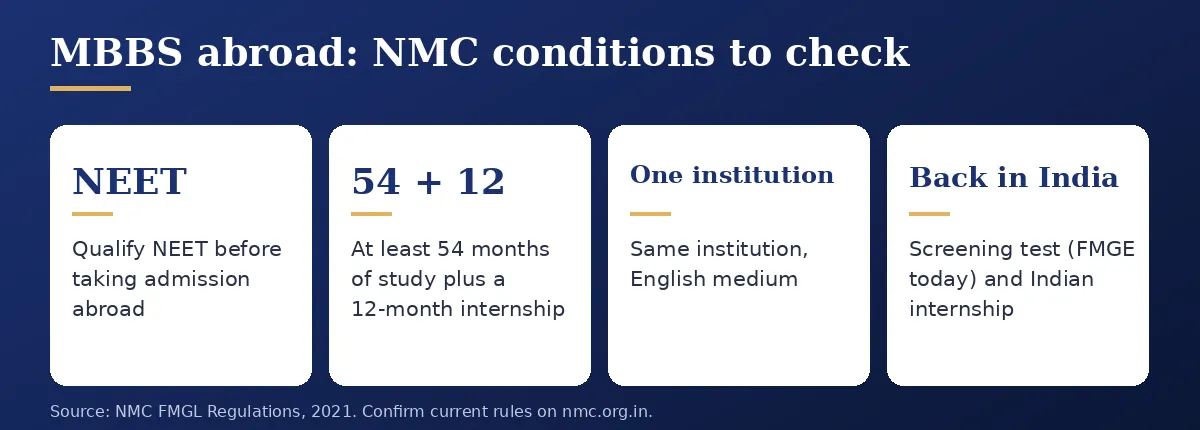
- NEET qualification before taking admission abroad.
- At least 54 months of medical study, plus a 12-month internship in the same foreign institution.
- The whole course at one institution in one country, taught in English medium.
- Passing India's screening test (the FMGE today) and completing the Indian internship before permanent registration.
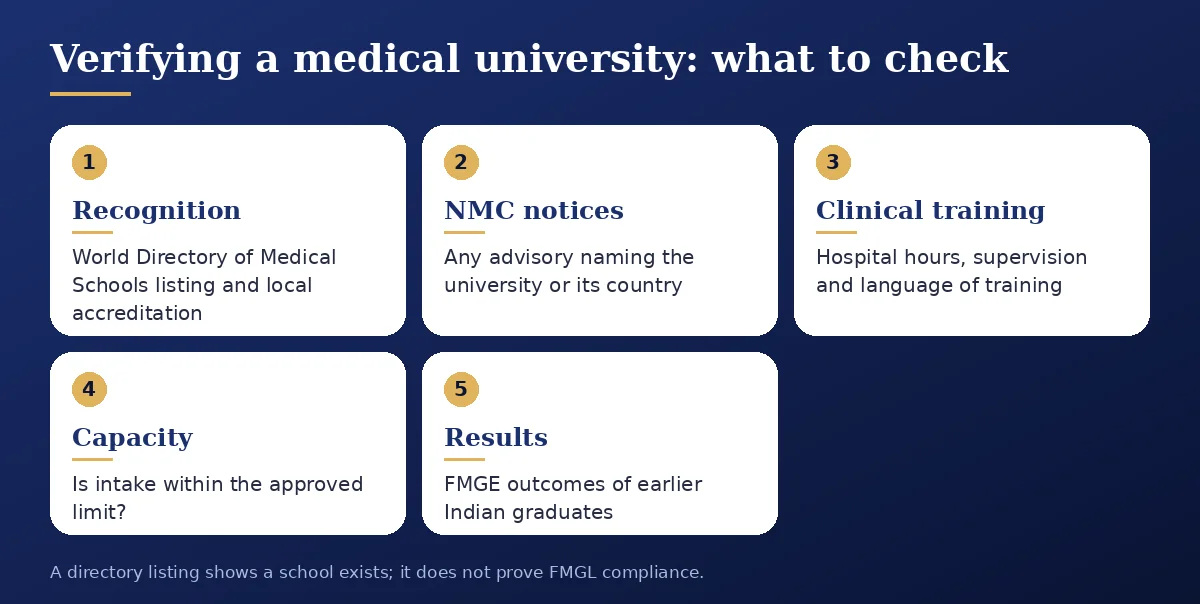
- Recognition: is the university listed in the World Directory of Medical Schools, and is it accredited locally?
- NMC notices: has the NMC issued an advisory naming it or its country?
- Clinical training: how many hospital hours, with what supervision, and in which language?
- Capacity: is intake within the university’s approved limit?
- Results: what are earlier Indian graduates’ FMGE outcomes?
The order matters. Do not spend time comparing hostels and food at a university that fails Level 2 or Level 3.
The six levels of verification explained
Level 1: does the school exist?
The World Directory of Medical Schools lists recognised medical schools. A listing shows that the school exists, but it does not prove that its programme meets the FMGL conditions.
Level 2: is it accredited at home?
Each country has its own authority. Georgian MD programmes are accredited by NCEQE, whose list is published at eqe.ge; see MBBS in Georgia. Kyrgyzstan introduced state accreditation in 2026, with the Embassy of India publishing lists of institutes that did not pass; see MBBS in Kyrgyzstan. In the Philippines, CHED recognition matters; see MBBS in the Philippines.
Level 3: has anyone warned against it?
The NMC and Indian embassies publish notices. The 2026 note on Uzbekistan named specific institutions; see MBBS in Uzbekistan. A notice does not always mean a ban, but it means you must ask hard questions in writing.
Level 4: does the programme fit the FMGL conditions?
Count the months of medical study, separately from the internship. Check English medium for lectures, exams and clinical training. Ask whether the curriculum covers the Schedule-I subjects and whether it is available for review, because the regulations expect that. See the NMC guidelines explainer.
Level 5: does it produce licensed doctors?
Ask for the number of Indian graduates who sat the FMGE and how many passed, for which sessions and on which attempt, and talk to at least two current Indian students and two graduates. The FMGE overall pass rate was about 12.8% in June 2026, so ask for specifics, not slogans.
Level 6: is the contract clean?
Check the fee schedule for all years, refund conditions, the language of the contract and that payment goes to the university’s official account. See the fees guide.
Questions to ask in writing
- How many months is the programme, excluding the internship?
- Where is the 12-month internship, and is it in the same institution?
- What is the complete fee schedule for all years?
- What happens if admission or the visa is refused?
- Which batches are English medium, and are clinical rotations taught and examined in English?
- What is your current accreditation status, and what is the validity period?
- What is the approved intake capacity for my batch?
Copy-and-paste email: “Dear Admissions Office, before I proceed with admission, please confirm in writing: (1) programme length in months excluding internship; (2) where and how the 12-month internship is done; (3) English-medium status of lectures, exams and clinical training; (4) your current accreditation certificate and validity; (5) the complete fee schedule for all years with currency; (6) refund terms if my visa is refused; (7) the FMGE results of Indian graduates for the last three sessions. Thank you.”
Want a written second opinion before you pay anything?
Send us your NEET result, shortlist or offer letter. A counsellor will check it against the NMC conditions and tell you plainly what to ask. Free, with no payment or commitment.
Call +91 95400 01774What proof is strong, and what is weak
| Strong | A dated accreditation certificate you can match to the official authority; the NMC or Embassy notice itself; a signed contract with an itemised fee breakup; FMGE results you can cross-check; conversations with current Indian students you contacted yourself. |
|---|---|
| Weak | A brochure; a website banner saying “NMC approved”; a screenshot of a notice; a consultant’s verbal assurance; testimonials chosen by the university. |
Be careful with the phrase “NMC approved”. The regulations set conditions a student’s programme must meet; treat the phrase as a claim to verify, and ask for the document behind it.
Red flags
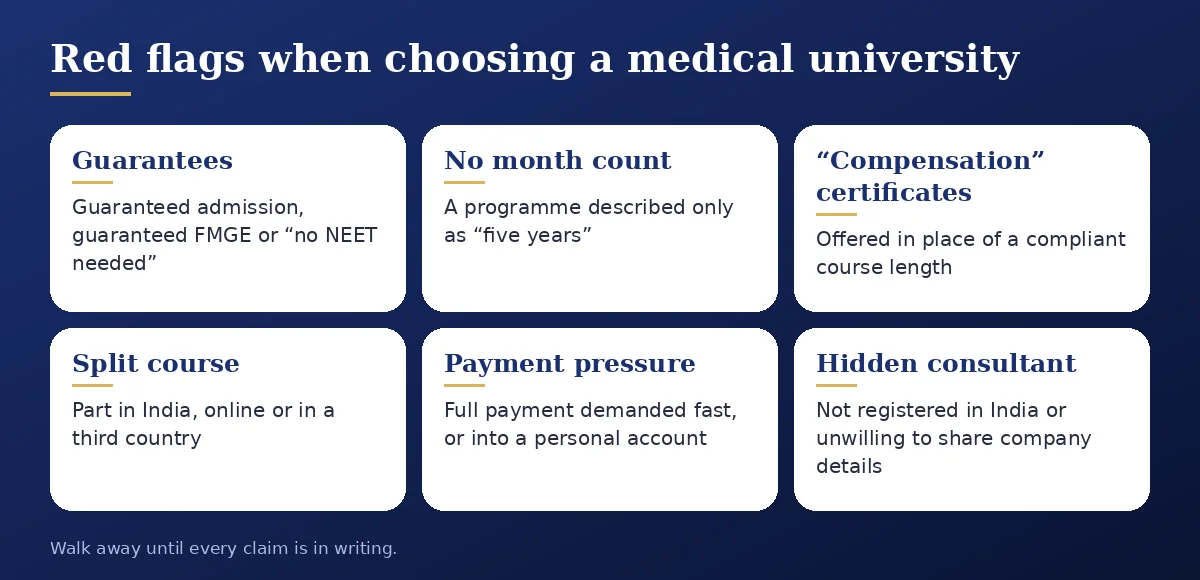
- Guaranteed admission, guaranteed FMGE success or “no NEET needed” promises.
- A programme described only as “five years” with no month count.
- “Compensation” certificates in place of a compliant course length.
- Part of the course in India, online or in a third country, which the FMGL does not allow.
- Pressure to pay the full amount quickly, or into a personal account.
- A consultant not registered in India, or one who will not share company details. The Embassy of India in Bishkek advises verifying a consultant’s CIN, TAN and PAN.
See country-specific cautions for Uzbekistan, Kyrgyzstan and Georgia, and the pillar MBBS abroad guide.
Rules and advisories change. Confirm the current position on nmc.org.in and with the university in writing before you pay. We never promise admission, visas or exam results.
Related reading: Best countries for MBBS abroad · FMGE and NExT requirements.

Frequently asked questions
How do I know a medical university abroad is genuine?
Check recognition and listing in the World Directory of Medical Schools, local accreditation, any NMC or Embassy advisories, and get course length and internship details in writing.
Is a recognised university automatically valid in India?
No. It must also meet the NMC FMGL conditions, including 54 months of study and a 12-month internship in the same institution.
Where can I see FMGE results by university?
Ask the university for Indian graduates’ results and compare them with NBEMS publications.
Can a consultant choose the university for me?
A consultant can shortlist, but you should verify each claim yourself in writing.
What does “NMC approved university” mean?
Treat it as a claim to verify. The regulations set conditions a student’s programme must meet, so ask for the document behind any such claim.
Can part of the MBBS be done in India?
No. The FMGL requires the entire course, training and internship outside India in the same foreign institution.
What if my university loses accreditation?
You could be left uncertain, as Indian students in Kyrgyzstan were in 2026, and Medical Dialogues reports that the NMC does not allow transfers to other institutes. Choose a university with a clean, current accreditation record.
How many current students should I speak to?
At least two current Indian students and two graduates, contacted independently of the university or consultant.
Sources and further reading
Official notices and reports used for this page: National Medical Commission: FMGL Regulations, 2021 and student advisories · Embassy of India, Bishkek: student advisory with the FMGL conditions (updated 23 April 2026) · World Directory of Medical Schools. Media reports are secondary sources, so confirm each point against the NMC’s own notices and the official advisory pages.
Rules and advisories change. Confirm the current position on nmc.org.in and with the university in writing before you pay. We never promise admission, visas or exam results.