
To study MBBS abroad and keep the option of practising in India, you need to qualify NEET before admission, hold the Class 12 science subjects universities require and choose a programme that meets the NMC’s FMGL Regulations, 2021. Universities add their own conditions on top. This guide separates the two questions families often mix up: can I apply, and can I practise in India afterwards?
Quick answer: Indian students who want to practise in India after an MBBS abroad must qualify NEET before taking admission, have Class 12 with Physics, Chemistry, Biology and usually English, be at least 17 by 31 December of the admission year (a common university rule) and choose a programme of at least 54 months plus a 12-month internship at one foreign institution, taught in English. Eligibility to apply is set by the university; eligibility to practise in India is set by the NMC.
Key facts: MBBS abroad eligibility at a glance
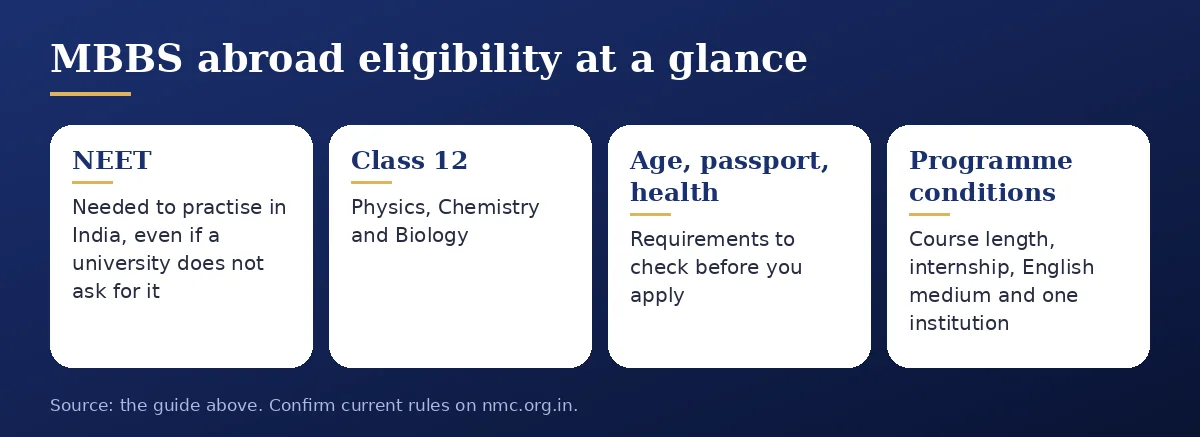
| NEET | Qualification before taking admission abroad is required to practise in India (FMGL Regulations, 2021) |
|---|---|
| Class 12 | Physics, Chemistry and Biology, and usually English; minimum marks are set by the university and the NEET bulletin |
| Age | Universities commonly require 17 years on or before 31 December of the admission year; confirm with your university |
| Who the NMC rules cover | Indian citizens and Overseas Citizens of India (OCI) |
| Applies to | Students who enrolled in a foreign medical institution on or after 18 November 2021; earlier admissions fall under older screening rules |
| Course conditions | At least 54 months plus a 12-month internship in the same foreign institution, English medium, whole course in one country |
| Time limit | The foreign course must be completed within ten years of joining (FMGL Schedule-I) |
| Last reviewed | 18 November 2026 |
Two different questions: eligible to apply, eligible to practise
Most confusion about MBBS abroad eligibility comes from treating these as one question.
- Eligible to apply is decided by the foreign university and its admission rules: age, Class 12 subjects and marks, passport, medical fitness and sometimes an interview or entrance test. Some universities admit students without NEET.
- Eligible to practise in India is decided by the NMC under the FMGL Regulations, 2021, and depends on NEET timing, the programme’s length and structure, the language of teaching and the exam you pass afterwards.
A university can accept you while your degree still fails the NMC conditions. That is why we ask every family to check both lists before paying any fee.
The NEET requirement
Under the FMGL Regulations, 2021, Indian students who want to practise in India must qualify NEET before taking admission to a foreign medical course. Some universities admit students without NEET, but that does not remove the NMC requirement: the degree would still not lead to registration in India. See MBBS abroad after NEET for how to use your result.
The result must be valid in the year you take admission. Sources describe different validity windows, so confirm the current position on nmc.org.in and in the NTA’s NEET-UG bulletin before relying on an older scorecard. If you did not qualify NEET, an MBBS abroad will not give you a route to practise in India under the current regulations, and you should weigh a re-attempt or other options before paying any deposit.
Class 12: Physics, Chemistry and Biology
Universities generally expect a Class 12 pass with Physics, Chemistry and Biology, and often English. Many publish a minimum aggregate, commonly around 50% for the general category with a lower threshold for reserved categories, but the figure varies by university and by the NTA’s NEET-UG criteria. Confirm the exact minimum in the NEET bulletin and in the university’s admission notice, and keep your Class 10 and 12 mark sheets and certificates ready.
If you completed Class 12 through an unusual board or route, ask the university in writing whether it accepts your certificate and whether any equivalence or attestation is needed, before you pay a fee.
Age, passport and health requirements
- Age: universities commonly require a minimum age of 17 years on or before 31 December of the admission year.
- Passport: valid for the full programme or renewable in time, with enough blank pages for visas and residence permits.
- Medical fitness: a fitness certificate and tests the destination country requires, such as an HIV test.
- Police clearance: a clearance certificate where the country or university asks for one.
- Funds: bank statements or sponsor documents showing the funds the visa office asks for.
The country page for your shortlist, for example Georgia, Kazakhstan or Russia, lists what applies there.
Who the NMC rules cover
The NMC advisories refer to Indian citizens and Overseas Citizens of India (OCI). The FMGL Regulations apply to students who enrolled in a foreign medical institution on or after 18 November 2021; earlier admissions fall under the older Screening Test Regulations, 2002. If you are an OCI cardholder or your enrolment date is close to that cutoff, read the notice that applies to your situation instead of relying on a general article.
Conditions your programme must meet
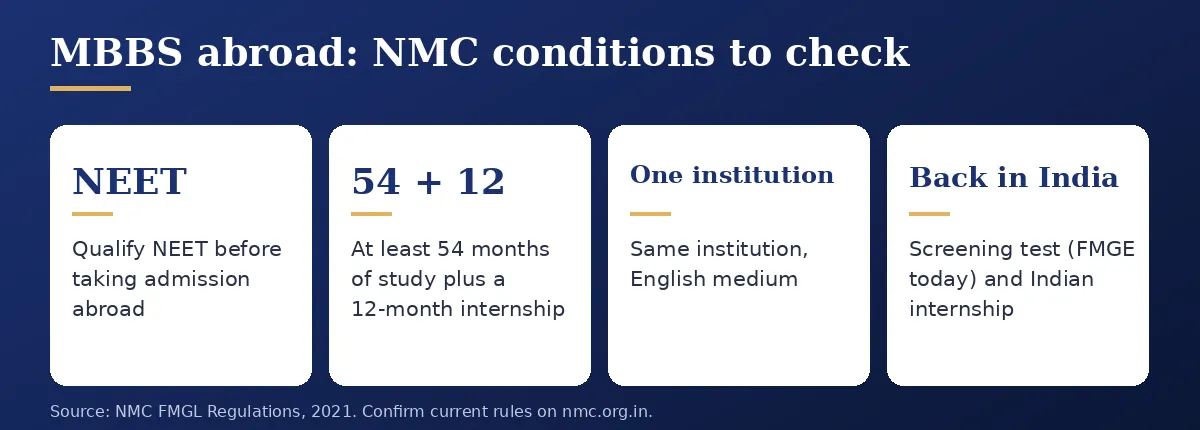
- NEET qualification before taking admission abroad.
- At least 54 months of medical study, plus a 12-month internship in the same foreign institution.
- The whole course at one institution in one country, taught in English medium.
- Passing India's screening test (the FMGE today) and completing the Indian internship before permanent registration.
The Embassy of India in Bishkek publishes the full text of the conditions in its student advisory. In summary, the foreign course must lead to a degree equivalent to the Indian MBBS in duration and content, the 12-month internship must be in the same foreign institution, the degree must be taught in English medium, the mandatory subjects in Schedule-I must be covered, the graduate must be registered or licensed to practise in the country that awarded the degree at par with that country’s citizens, and after returning the graduate must complete a supervised internship in India and clear the mandated test. The entire course must be done outside India in the same institution and be completed within ten years of joining.
Eligibility to apply is one thing; eligibility to practise in India depends on the programme. Check both before paying. Our NMC guidelines explainer walks through each condition.
Eligibility checklist you can use today
| NEET scorecard | Shows you qualified, and which year. Confirm validity for your admission year. |
|---|---|
| Class 10 and 12 records | Mark sheets and certificates; Physics, Chemistry and Biology marks match the university’s minimum. |
| Passport | Valid with margin; photographs in the required format. |
| Age proof | Birth certificate or equivalent showing you meet the 17-year rule by 31 December. |
| Health and clearance | Medical fitness certificate, required tests and, where asked, police clearance. |
| Programme proof | Written confirmation of course length in months, internship location, English medium and accreditation. |
| Funds | A written six-year budget and the proof of funds the visa office asks for. |
Start collecting documents several months before the intake so a missing stamp does not cost you a year. The admission process guide shows where each document is used.
Have an offer letter or fee quote you are unsure about?
Send it across. We will point out what is missing, such as month counts, internship terms and refund conditions. Free, no commitment.
Call +91 95400 01774Common eligibility mistakes
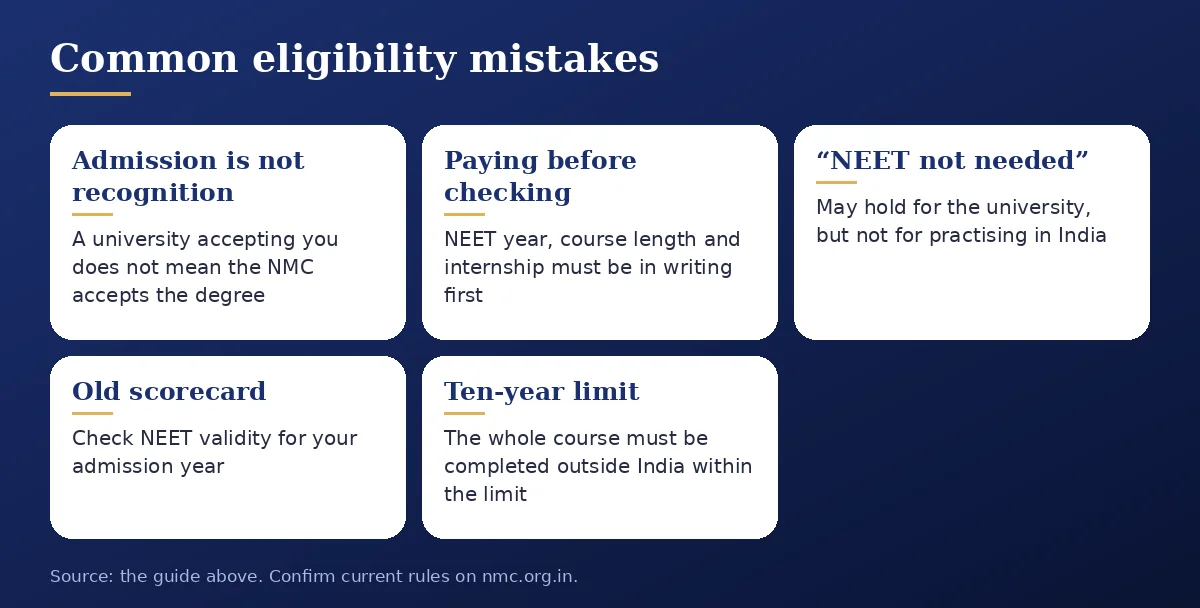
- Assuming that a university accepting you means the NMC will accept the degree.
- Paying a seat-blocking fee before checking the NEET year, course length and internship in writing.
- Believing a promise that NEET is “not needed”. It may not be needed for the university, but it is needed for practising in India.
- Relying on an old NEET scorecard without checking its validity for the admission year.
- Ignoring the ten-year completion limit and the rule that the whole course must be outside India.
Related reading: Best countries for MBBS abroad · How to verify a medical university · The full MBBS abroad guide.

Frequently asked questions
Can I study MBBS abroad without NEET?
You may find universities that admit without it, but to practise in India the NMC requires NEET qualification before admission under the FMGL Regulations, 2021.
Is Class 12 PCB compulsory for MBBS abroad?
Universities generally require Physics, Chemistry and Biology, often with English. Confirm the minimum marks with the university and the NEET bulletin.
What is the minimum age for MBBS abroad?
Universities commonly require 17 years on or before 31 December of the admission year. Confirm with the specific university.
What is the minimum study period for MBBS abroad?
At least 54 months of medical study plus a 12-month internship in the same institution, with the whole course done outside India in one institution.
Do the rules apply to OCI students?
NMC advisories refer to Indian citizens and OCI. Check the notice that applies to you.
Do the FMGL Regulations apply to students admitted before 2021?
The FMGL Regulations apply to students who enrolled on or after 18 November 2021. Earlier admissions fall under the older Screening Test Regulations, 2002.
Is my old NEET score still valid for admission?
Validity depends on the admission year and sources describe different windows. Confirm on nmc.org.in and in the NEET bulletin.
Does a low NEET score matter for MBBS abroad?
The NMC condition is NEET qualification. Universities may have their own criteria, and your choice affects cost and risk, so compare options carefully.
Sources and further reading
Official notices and reports used for this page: National Medical Commission: FMGL Regulations, 2021 and student advisories · Embassy of India, Bishkek: student advisory with the FMGL conditions (updated 23 April 2026) · National Testing Agency: NEET-UG information. Media reports are secondary sources, so confirm each point against the NMC’s own notices and the official advisory pages.
Rules and advisories change. Confirm the current position on nmc.org.in and with the university in writing before you pay. We never promise admission, visas or exam results.