
Once you have your NEET result, the choice is between Indian seats and studying abroad. If you go abroad, qualifying NEET before admission keeps the NMC pathway open. The next job is shortlisting programmes that meet the FMGL Regulations, not just choosing a country. This guide gives you a step-by-step plan, from reading your result to a verified shortlist.
Quick answer: After NEET, first find out which Indian seats your result realistically gives you and what they cost. If you still want to go abroad, shortlist three to five universities (not countries), check each against the NMC conditions (54 months plus a 12-month internship at one institution, English medium, then the Indian screening test), price the full six years in writing and verify accreditation before paying anything. Qualifying NEET before admission is what keeps the route to practise in India open.
Key facts: MBBS abroad after NEET at a glance
| What NEET does | Qualifying NEET before admission is the NMC requirement for practising in India after a foreign MBBS |
|---|---|
| Score validity | Must be valid for your admission year; sources describe different windows, so confirm on nmc.org.in |
| Compare first | Indian seats you can realistically get, with total cost, duration and licensing risk |
| Shortlist unit | Universities, not countries; note each course length in months |
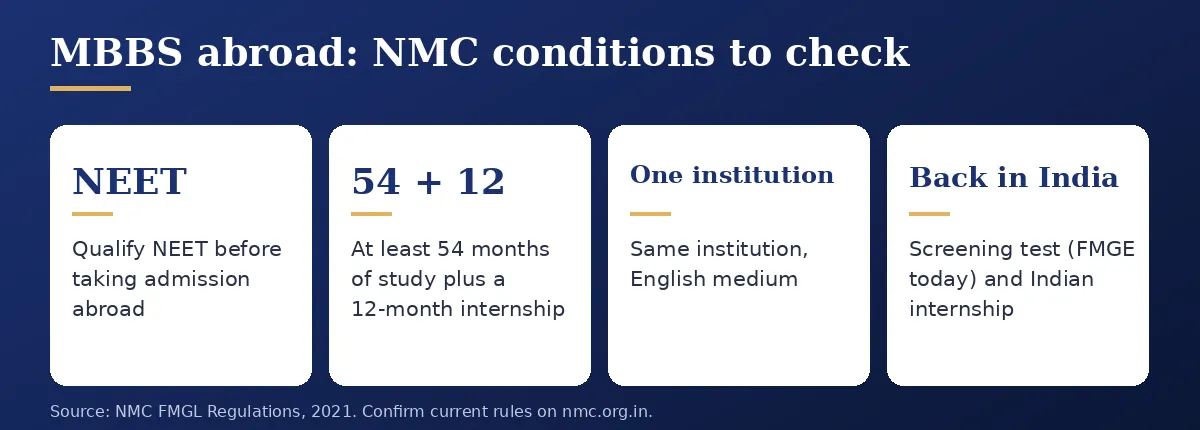
| Rules to measure against | NEET, 54 months plus a 12-month internship in one institution, English medium, then FMGE and the Indian internship |
| Published budgets | Commonly about ₹20 lakh to ₹50 lakh or more for six years, depending on country and university |
| Pass rate to plan for | About 12.8% overall in the FMGE June 2026 session, per a government statement in Parliament |
| Last reviewed | 18 November 2026 |
Using your NEET result
Qualifying NEET is the NMC requirement for Indian students who want to practise in India after a foreign MBBS. The result must be valid for the year you take admission, and sources describe different validity windows, so confirm the current position on nmc.org.in before relying on an older score. Keep the scorecard, admit card and identity documents in one folder before you speak to any university or consultant.
A qualifying score does not make foreign admission automatic. Universities run their own selection and verify documents, and your score influences which options are realistic, how much risk you take on and what the total budget looks like.
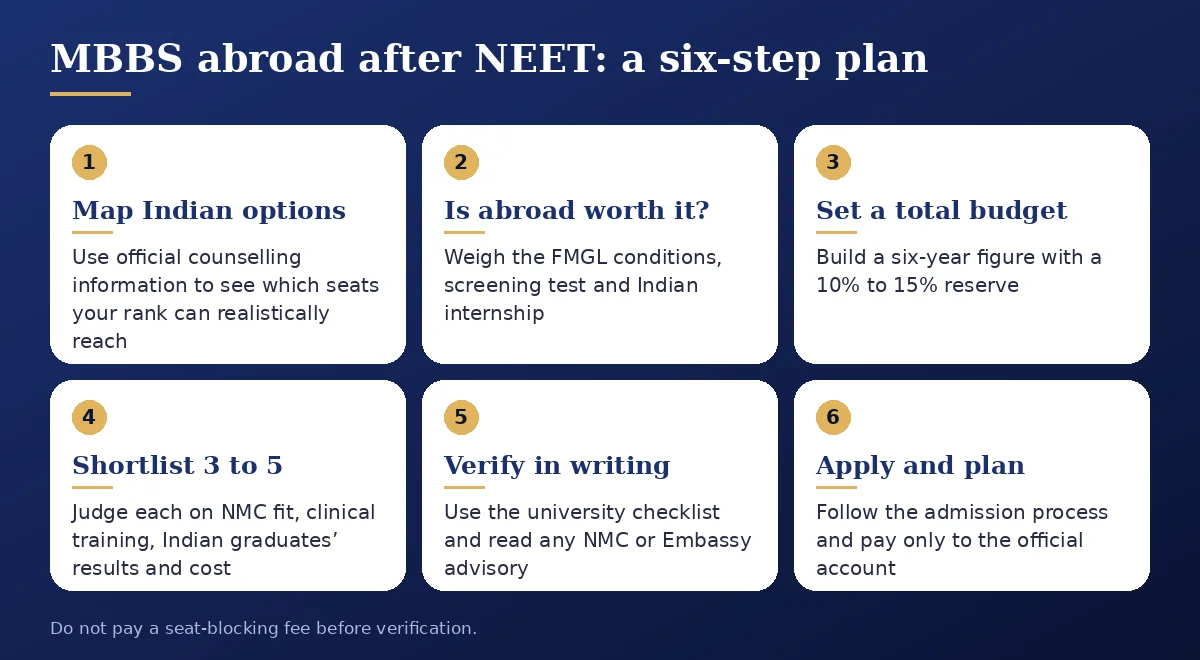
A six-step plan after NEET
- Map your Indian options. Use the official counselling information to see which government and private seats your rank can realistically reach, and what each costs over the whole course.
- Decide whether abroad is worth the extra steps. Going abroad means the FMGL conditions, the screening test and an Indian internship. Read MBBS in India vs abroad and the challenges guide.
- Set a total budget. Build a six-year figure with a 10% to 15% reserve. Our fees guide shows what to include.
- Shortlist three to five universities. Judge each on NMC fit, clinical training, results of Indian graduates and cost.
- Verify in writing. Use the university checklist and read any NMC or Embassy advisory for the country.
- Apply and plan the paperwork. Follow the admission process, and pay only to the university’s official account.
India or abroad? A fair comparison
More than 20 lakh students appear for NEET-UG every year while India has roughly 1.2 lakh MBBS seats, which is why many qualified students look abroad. The comparison is not only about price.
| Entry | India: NEET counselling with limited seats. Abroad: you apply to universities but still need NEET to practise in India. |
|---|---|
| Duration | India: 4.5 years plus a one-year internship. Abroad: at least 54 months plus a 12-month internship, then an Indian internship after the screening test. |
| Licensing | India: register directly. Abroad: pass the screening test, currently the FMGE. |
| Cost | Varies widely in both. Compare the full course, not the first-year fee. |
| Main risks | India: seat availability and fees. Abroad: regulatory change, accreditation, payments, licensing exam. |
If you can secure a government seat, or a private seat you can afford, in India, that route usually carries fewer regulatory risks. Abroad makes sense when you have a clear budget, a verified university and a plan to prepare for the Indian licensing exam from the first year.
How to shortlist safely
- List universities, not countries, and note each course length in months.
- Check each against the NMC conditions, including the 12-month internship in the same institution.
- Read the NMC and Embassy advisories for the country, for example Uzbekistan, Georgia, Kyrgyzstan and the Philippines.
- Ask for FMGE results of earlier Indian graduates, and speak to students and alumni.
- Get every cost in writing before paying anything.
A simple scorecard helps: score each shortlisted university from 1 to 5 on NMC fit, accreditation, clinical exposure, English medium, graduate FMGE outcomes, total cost and daily-life fit. A university that scores 1 on NMC fit or accreditation is out, whatever its price.
Want a written second opinion before you pay anything?
Send us your NEET result, shortlist or offer letter. A counsellor will check it against the NMC conditions and tell you plainly what to ask. Free, with no payment or commitment.
Call +91 95400 01774Rules to measure against
- NEET qualification before taking admission abroad.
- At least 54 months of medical study, plus a 12-month internship in the same foreign institution.
- The whole course at one institution in one country, taught in English medium.
- Passing India's screening test (the FMGE today) and completing the Indian internship before permanent registration.
If a university cannot show in writing how its programme meets each point, treat that as a warning. For the legal wording, read our NMC guidelines explainer.
Three common situations
Your score is close to a government seat
Weigh a re-attempt, or a private seat you can afford, against a six-year foreign programme and its extra licensing step. A one-year delay costs time, but a mis-chosen foreign programme can cost years.
Private seats in India are beyond your budget
Foreign universities may be cheaper overall, but only if the programme is compliant and you budget for the full six years plus FMGE preparation. Read what a real budget includes and the living costs guide.
Your score is low but qualifying
The NMC condition is NEET qualification, but universities may have their own criteria, and the FMGE is demanding. Be especially careful about quality of teaching, and avoid any promise that a low score does not matter.
Mistakes to avoid after NEET
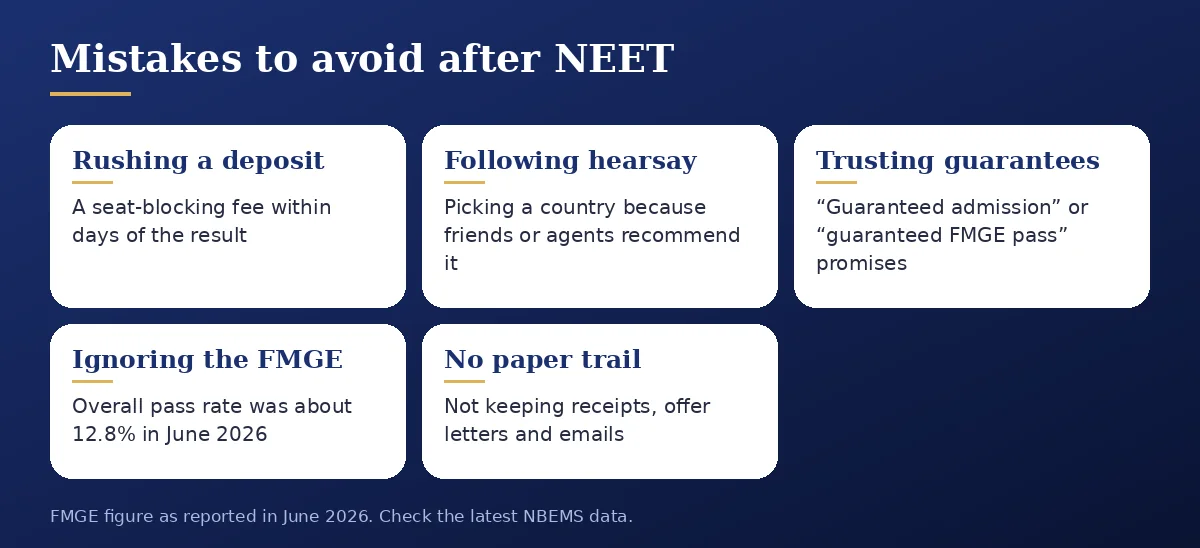
- Paying a seat-blocking fee within days of the result, before verification.
- Choosing a country because friends or agents recommend it, without checking the specific university.
- Relying on promises of “guaranteed admission” or a “guaranteed FMGE pass”.
- Ignoring the FMGE: the overall pass rate was about 12.8% in June 2026, so plan preparation from the early years. See FMGE and NExT requirements.
- Not keeping copies of receipts, offer letters and emails.
Rules and advisories change. Confirm the current position on nmc.org.in and with the university in writing before you pay. We never promise admission, visas or exam results.
Related reading: MBBS in India vs abroad · MBBS abroad eligibility · the full MBBS abroad guide.

Frequently asked questions
Can I go abroad for MBBS after qualifying NEET?
Yes. Qualifying NEET before admission is what the NMC requires if you want to practise in India afterwards.
Does a low NEET score matter for MBBS abroad?
The NMC condition is NEET qualification. Universities may have their own criteria, and your choice affects cost and risk, so compare options carefully.
Is my old NEET score still valid?
Validity depends on the admission year, and sources differ. Confirm on nmc.org.in.
Which country is best after NEET?
There is no single best. Judge each programme on NMC compliance, clinical training, graduate results and total cost.
Should I take a seat in India instead of going abroad?
If you can secure a government seat, or a private seat you can afford, that route usually carries fewer regulatory risks. Compare the full costs and risks of both.
How many universities should I shortlist?
Three to five. Compare them on the same written cost list and the same verification checklist.
When should I pay a deposit?
Not before verifying accreditation, course length, internship and all costs in writing, and then only to the university’s official account.
How hard is the exam after MBBS abroad?
The FMGE overall pass rate was about 12.8% in June 2026, so preparation and teaching quality matter.
Sources and further reading
Official notices and reports used for this page: National Medical Commission: FMGL Regulations, 2021 and student advisories · National Testing Agency: NEET-UG information · NBEMS: FMGE notices. Media reports are secondary sources, so confirm each point against the NMC’s own notices and the official advisory pages.
Rules and advisories change. Confirm the current position on nmc.org.in and with the university in writing before you pay. We never promise admission, visas or exam results.